
Understanding Incretin Medicines: One, Two, and Three Pathways
A clear guide to GLP-1, GIP, and the receptor science behind today's medicines and tomorrow's research.

Best for
- People comparing semaglutide and tirzepatide
- Readers who want a deeper, plain-language mechanism explanation
First, one receptor does not mean one location
A receptor is a signal receiver on or in a cell. When a medicine activates a receptor, it starts a chain of messages inside that cell. The same receptor family can be present in more than one part of the body, so a medicine that targets one receptor family may still influence several organs and systems.
Semaglutide is called a single-receptor agonist because it selectively activates the GLP-1 receptor family—not because it works at only one physical location. Tirzepatide is called a dual-receptor agonist because one molecule activates both GLP-1 and GIP receptor families.
The medication names people recognize
- Semaglutide is the active ingredient in Ozempic and Wegovy. The products have different FDA-approved indications, doses, and instructions even though the active molecule is the same.
- Tirzepatide is the active ingredient in Mounjaro and Zepbound. Those products also have different FDA-approved indications and instructions.
- A brand name does not identify the receptor pathway by itself. The generic ingredient tells you which molecule is doing the signaling.
What GLP-1 signaling does
GLP-1 is an incretin hormone released after eating. Medicines such as semaglutide are designed to keep GLP-1 receptor signaling active longer than the body's natural hormone.
- Brain and appetite pathways: GLP-1 receptor signaling can reduce hunger and increase feelings of fullness.
- Pancreas: when blood glucose is elevated, GLP-1 receptor signaling increases insulin release and lowers glucagon secretion.
- Stomach and digestion: semaglutide can delay gastric emptying, particularly early after a meal and during the initial treatment period. This may contribute to fullness and to symptoms such as nausea.

These medicines are not accurately described as blocking nutrient absorption. Their better-established actions involve appetite signaling, glucose-dependent pancreatic effects, and changes in gastric emptying.
What tirzepatide adds with GIP
GIP stands for glucose-dependent insulinotropic polypeptide. Like GLP-1, it is an incretin hormone released in response to food. Tirzepatide activates both GIP and GLP-1 receptors in a single molecule.
- GLP-1 receptor activation contributes to appetite regulation, glucose-dependent insulin release, lower glucagon, and delayed gastric emptying.
- GIP receptor activation adds a second glucose-responsive incretin signal and may contribute to tirzepatide's overall effects on appetite and metabolism.
- The exact contribution of each receptor—and how the two signals interact in different tissues—is still an active area of research.
Does the GIP pathway mean less nausea?
There is a biologically plausible reason for this question. In animal studies, activating GIP receptors reduced nausea-like behavior and vomiting caused by GLP-1 receptor activation. Researchers have proposed that GIP signaling in hindbrain circuits may dampen some aversive signals.

That finding is promising, but it is not the same as proving that tirzepatide consistently causes less nausea in people. In direct clinical trials, gastrointestinal side effects were common with both tirzepatide and semaglutide. Individual tolerability varies, and one person may feel better on one medicine while another does not.
- Both medicines can cause nausea, vomiting, diarrhea, constipation, abdominal discomfort, and reduced appetite.
- Symptoms often occur during dose escalation, but timing and severity vary.
- A difficult experience with one medicine does not prove that another will be easier, although a clinician may consider individual history when discussing options.
- Do not switch, stop, restart, or change a dose without the prescribing clinician.
GIP is not GLP-2
Tirzepatide's second target is the GIP receptor, not the GLP-2 receptor. GLP-2 is a different gut hormone with a different receptor and different clinical uses. Calling tirzepatide a “GLP-1 plus GLP-2” medicine changes the biology and is incorrect.
What people mean by a future triple agonist
A triple agonist under study, such as retatrutide, is designed to activate three established receptor families: GIP, GLP-1, and glucagon. The third target is the glucagon receptor. Researchers are studying whether combining these signals can change appetite, glucose regulation, and energy use.
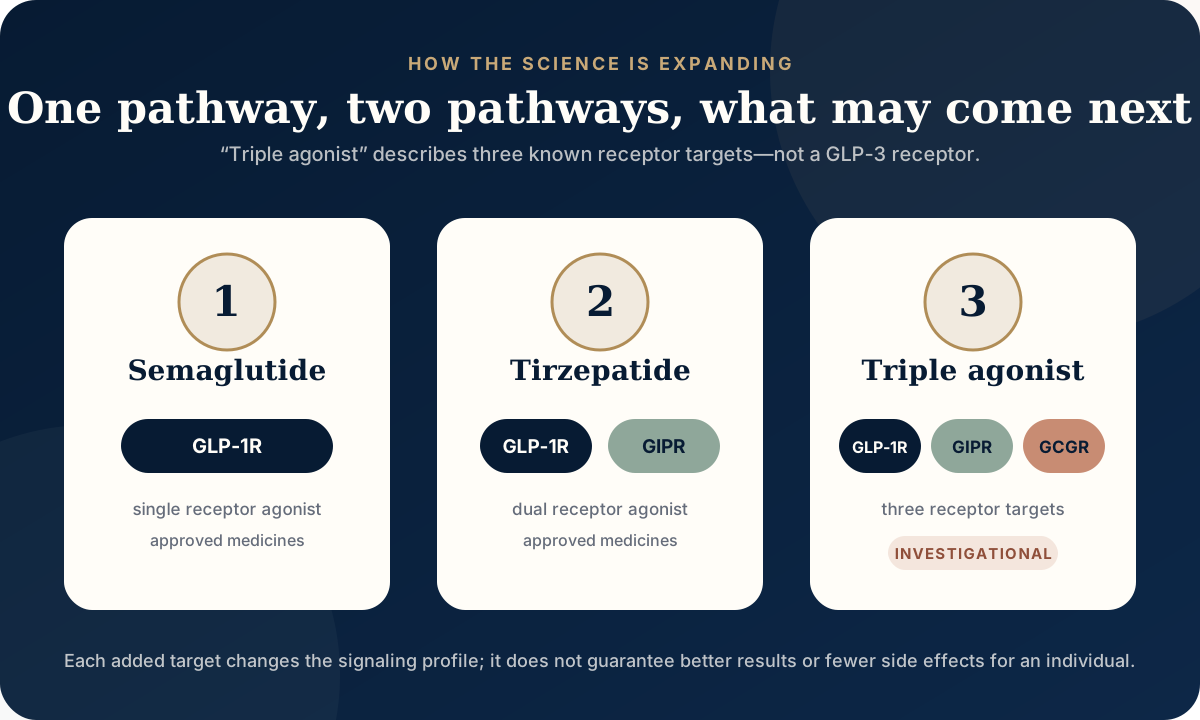
This is sometimes shortened informally to “GLP-3,” but that wording is misleading. It is not a new GLP-3 receptor. Triple agonists remain investigational and require clinical trials and regulatory review before routine use.
How the options differ in real life
Receptor count is only one part of medication choice. FDA-approved indication, medical history, other medicines, contraindications, side-effect pattern, access, and the care plan all matter. “Two receptors” does not automatically mean “twice as strong,” and it does not make one medicine universally better.
- Which medicine is approved for the condition being treated?
- What gastrointestinal symptoms or other side effects have occurred before?
- What dose-escalation plan is appropriate for this individual?
- What symptoms should prompt a call to the care team?
- How will benefit, tolerability, nutrition, hydration, and muscle preservation be followed?
The practical takeaway
Semaglutide sends one type of receptor signal through GLP-1 receptors located across multiple tissues. Tirzepatide sends two types of receptor signals through GLP-1 and GIP receptors. GIP may modify nausea pathways, but it does not guarantee fewer side effects. Future triple agonists add glucagon-receptor activity and remain investigational. The most useful comparison is not simply one receptor versus two; it is which approved medicine best fits the individual when benefits, risks, tolerability, and clinical goals are considered together.
Educational only — always discuss medication choices with your care team.